For laboratory research use only. Not for human consumption.

Product | Pinealon 20MG

Pinealon 20MG

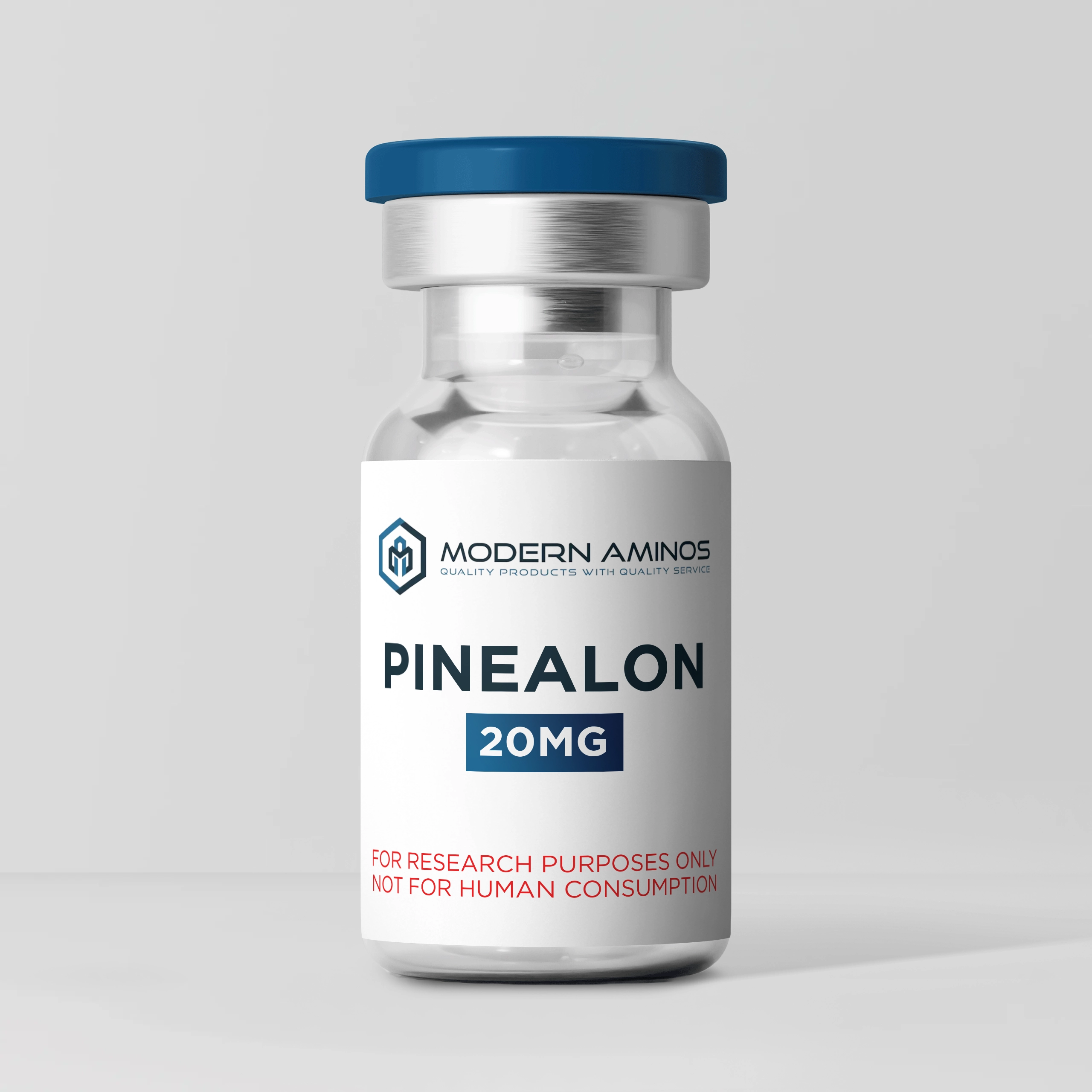
Pinealon 20MG (Glu-Asp-Arg / EDR tripeptide, L-glutamyl-L-aspartyl-L-arginine) is a synthetic tripeptide bioregulator for peptide-DNA and peptide-histone interaction research. In biophysical studies, the EDR sequence partly enters the DNA major groove, contacting guanine N7 and O6, and it binds histone tails in fluorescence-quenching assays. Supplied as 20 mg of lyophilized powder in a sealed vial. CAS 175175-23-2.

€55.00

What is Pinealon 20MG?

Pinealon (L-glutamyl-L-aspartyl-L-arginine, also called Glu-Asp-Arg, EDR, EDR tripeptide, H-Glu-Asp-Arg-OH, and the Pinealon bioregulator; CAS 175175-23-2) is a synthetic tripeptide built from three L-amino acids. It belongs to the family of short regulatory peptides, two to four residues long, that are studied for how they bind DNA and histone proteins. Pinealon is a peptide rather than a single amino acid, and Modern Aminos lists it as a research chemical rather than a supplement: a defined sequence with its own PubChem record (CID 10273502). Its activity in the literature comes from the way a small, highly charged peptide recognizes particular DNA sequences and histone surfaces.

Biophysical work using spectral methods, NMR, viscometry, and molecular dynamics showed that the EDR peptide partly penetrates the major groove of DNA and affects guanine N7 and O6 atoms, and that magnesium ions promote the interaction by screening DNA’s phosphate charges (Silanteva et al., 2019, PubMed 30762356). At the molecular level, Pinealon behaves as a sequence-selective DNA and histone ligand.

Batch-verified at Modern Aminos, Pinealon is supplied in 1 laboratory format:

  • 20 mg lyophilized powder, single sealed glass vial (SKU P-019)

Laboratories building peptide-nucleic acid binding panels often place Pinealon next to other public reference listings such as Bronchogen and Vilon, as well as Epitalon. For a closer look at the sequence and the binding studies, see What Is Pinealon? The Glu-Asp-Arg (EDR) Tripeptide Explained.

Chemical and Molecular Data for Pinealon 20MG

Compound Name Pinealon 20MG (Glu-Asp-Arg)
Research Category DNA- and histone-binding short peptide; synthetic tripeptide bioregulator; peptide-nucleic acid interaction reference compound
Quantity / Formats Offered 20 mg Lyophilized Powder (single sealed glass vial)
Peptide Sequence H-Glu-Asp-Arg-OH (EDR); all three residues L
Synonyms / Alt Names Glu-Asp-Arg, EDR, E-D-R, EDR tripeptide, H-Glu-Asp-Arg-OH, L-Glu-L-Asp-L-Arg, glutamyl-aspartyl-arginine, L-alpha-glutamyl-L-alpha-aspartyl-L-arginine, Pinealon bioregulator
CAS Number 175175-23-2
PubChem CID 10273502
ChEBI ID CHEBI:156374
EPA DSSTox Substance ID DTXSID601359159
Chemical Formula C15H26N6O8
Molecular Weight 418.40 g/mol
Exact Mass 418.1812 Da
Stereochemistry Three defined stereocenters, all L (S configuration)
Computed Properties (PubChem) XLogP3 -6.1; hydrogen-bond donors 8; hydrogen-bond acceptors 10; topological polar surface area 261 Å2; rotatable bonds 14
IUPAC Name (4S)-4-amino-5-[[(2S)-3-carboxy-1-[[(1S)-1-carboxy-4-(diaminomethylideneamino)butyl]amino]-1-oxopropan-2-yl]amino]-5-oxopentanoic acid
InChIKey QPRZKNOOOBWXSU-CIUDSAMLSA-N
SMILES Code C(C[C@@H](C(=O)O)NC(=O)[C@H](CC(=O)O)NC(=O)[C@H](CCC(=O)O)N)CN=C(N)N

Identity fields are drawn from PubChem CID 10273502 and ChEBI, with the CAS number cross-checked against the expert-curated EPA DSSTox record; purity and quantity values come from the lot certificate in the Certificate of Analysis tab.

What are the Mechanisms of Action?

The biochemical targets and binding logic of Pinealon in laboratory research include:

  • Major-groove contact with double-stranded DNA: Spectral, NMR, and viscometry measurements, supported by molecular dynamics, showed that the EDR peptide can partly penetrate the DNA major groove and affect the base atoms N7 and O6 of guanine (Silanteva et al., 2019).
  • Divalent-cation dependence: Magnesium ions promoted the DNA-EDR interaction by screening the negatively charged phosphate backbone, and the effect persisted in salt solutions (Silanteva et al., 2019). Buffer composition, especially Mg2+, is therefore a key variable in any binding assay with this peptide.
  • Sequence and methylation selectivity: In fluorescence-quenching experiments with 5,6-carboxyfluorescein-labeled deoxyribooligonucleotides, Stern-Volmer constants differed with peptide structure. Pinealon bound preferentially to CNG-containing sequences and favored CAG-containing ones, and the study reported that the peptides tested could recognize cytosine methylation status (Fedoreyeva et al., 2011).
  • Histone-tail binding: Glu-Asp-Arg was one of six short peptides that bound FITC-labeled wheat histones H1, H2B, H3, and H4, through the N-terminal histone regions. Binding was site specific, and DNA or oligonucleotides in complex with the histones could enhance or inhibit it (Fedoreyeva et al., 2013).
  • Modeled binding sites and promoter matches: Molecular modeling proposed two possible EDR binding sites, d(CCTGCC)2 and d(CCAGC)2, and matching sequences were mapped in the promoter regions of genes including PPARA, PPARG, and GPX1 (Khavinson et al., 2020, Figure 3 and Table 1). The same article summarizes in vitro evidence that EDR destabilizes DNA secondary structure and compacts the molecular coil.
  • Length as a selectivity factor: A systematic docking and molecular dynamics survey of all 400 standard dipeptides against B-form DNA found that the vast majority could not bind, identified 57 low-energy selective complexes, and concluded that selective binding can increase dramatically with peptide length (Kolchina et al., 2019). That frames why a tripeptide such as EDR is a useful step up from dipeptide references.
Assay Parameter Pinealon (Glu-Asp-Arg) Epitalon (Ala-Glu-Asp-Gly) / Bronchogen (Ala-Glu-Asp-Leu) Source
Preferred oligonucleotide motif (Stern-Volmer fluorescence quenching) CNG-containing; CAG favored Epitalon: CNG-containing, CAG favored / Bronchogen: CNG-containing, CTG favored Fedoreyeva 2011, abstract
Binding to FITC-labeled histones H1, H2B, H3, H4 Binds (N-terminal regions) Both bind (N-terminal regions) Fedoreyeva 2013, abstract
DNA groove contact (NMR, molecular dynamics) Partial major-groove penetration; guanine N7 and O6 not reported Silanteva 2019, abstract
Effect of Mg2+ on DNA binding Promotes binding (phosphate screening) not reported Silanteva 2019, abstract
Modeled DNA binding sites d(CCTGCC)2 and d(CCAGC)2 Epitalon: histones H1/3 and H1/6 (modeling) / Bronchogen: not reported Khavinson 2020, Figure 3; Khavinson 2020 (AEDG), abstract

What Does Published Research Show for Pinealon?

Peer-reviewed literature on Pinealon 20MG and its Glu-Asp-Arg sequence centers on nucleic acid binding, histone binding, and structural modeling:

  • DNA Binding Biophysics (PubMed): Spectral, NMR, viscometry, and molecular dynamics methods show EDR partly entering the DNA major groove, contacting guanine N7 and O6, with Mg2+ promoting the interaction (PubMed 30762356).
  • Oligonucleotide Selectivity (PubMed): Fluorescence-quenching constants show that Pinealon discriminates between oligonucleotide sequences and prefers CNG and CAG motifs, with the peptide panel also recognizing cytosine methylation status (PubMed 22117547).
  • Histone Binding (PubMed): Glu-Asp-Arg binds FITC-labeled wheat histones H1, H2B, H3, and H4 in a site-specific way that depends on the histone, the peptide, and any bound oligonucleotide (PubMed 23581987).
  • Binding-Site Modeling (PMC): A 2020 overview article proposes the d(CCTGCC)2 and d(CCAGC)2 binding sites, maps matching promoter sequences, and summarizes the DNA-destabilizing and coil-compacting effects seen in vitro (PMC7795577).
  • Peptide Length and DNA Selectivity (PMC): Systematic docking of all standard dipeptides against B-DNA shows that selective binding is rare for dipeptides and rises sharply with peptide length (PMC6847403).
  • Chemical Directory & Structure Verification (PubChem / ChEBI / EPA DSSTox): PubChem CID 10273502, ChEBI CHEBI:156374, and EPA DSSTox DTXSID601359159 agree on the formula C15H26N6O8, a molecular weight of 418.40 g/mol, CAS 175175-23-2, and InChIKey QPRZKNOOOBWXSU-CIUDSAMLSA-N.
  • Analytical Quality: Why chromatographic testing matters for reference materials is covered in Modern Aminos’ note on HPLC testing.

How does Pinealon compare to other compounds?

To map sequence-selective DNA and histone binding, researchers compare Pinealon against other short peptide reference compounds, including several available at Modern Aminos:

Compound / Reference Primary Target Class Core Mechanism of Action Research Focus & Profile
Pinealon 20MG Tripeptide (Glu-Asp-Arg), C15H26N6O8, 418.40 g/mol Partial major-groove DNA contact at guanine N7/O6; CNG- and CAG-preferring oligonucleotide binding; histone N-terminal binding DNA and histone binding biophysics, Mg2+ dependence, methylation-sensitive recognition
Bronchogen Tetrapeptide (Ala-Glu-Asp-Leu), C18H30N4O9, 446.5 g/mol CNG-preferring oligonucleotide binding with a CTG preference; histone N-terminal binding Side-by-side sequence-selectivity comparisons with Pinealon in the same assays
Vilon Dipeptide (Lys-Glu), C11H21N3O5, 275.30 g/mol Docking places Lys-Glu along the DNA minor groove, with a higher calculated interaction energy than free lysine or glutamic acid Minimal-length peptide-DNA docking reference (Khavinson et al., 2015)
Epitalon Tetrapeptide (Ala-Glu-Asp-Gly), C14H22N4O9, 390.35 g/mol CNG- and CAG-preferring oligonucleotide binding; modeled binding to linker histones H1/3 and H1/6 Histone-modeling comparisons (Khavinson et al., 2020)

Frequently Asked Questions (FAQs)

1. Is Modern Aminos a reliable place to buy Pinealon (Glu-Asp-Arg)?

Modern Aminos publishes a third-party certificate from Freedom Diagnostics Testing for Pinealon lot BX-P-M9W2 (reported July 17, 2026). It lists identity confirmed by LC-MS, HPLC-UV purity of 99.82% (vials at 99.80%, 99.83%, and 99.82%), an average net content of 20.09 mg per vial, an endotoxin pass by the Limulus Amebocyte Lysate method under USP <85>, and a PCR microbial screen pass. If you want to buy L-glutamyl-L-aspartyl-L-arginine as a documented reference material, the certificate is in the Certificate of Analysis tab.

2. Is Pinealon a peptide or an amino acid?

Pinealon is a peptide: specifically a tripeptide, three amino acids joined by two peptide bonds in the order L-glutamic acid, L-aspartic acid, L-arginine (Glu-Asp-Arg, or EDR in one-letter code). ChEBI defines it in exactly those terms (CHEBI:156374). Its individual building blocks are amino acids, but the linked chain is a peptide with its own formula, C15H26N6O8, and its own CAS number, 175175-23-2.

3. Is Pinealon a supplement or a research chemical?

Modern Aminos lists Pinealon as a research chemical: a defined synthetic tripeptide with a PubChem record (CID 10273502), a ChEBI entry, and a lot certificate. It is supplied only as a lyophilized powder in a sealed vial, and the published work on it focuses on peptide-DNA and peptide-histone binding chemistry.

4. What is the molecular target and primary function of Pinealon (Glu-Asp-Arg)?

The documented molecular partners of Pinealon are nucleic acids and histone proteins. Spectral, NMR, viscometry, and molecular dynamics work shows the EDR peptide partly entering the major groove of double-stranded DNA and affecting guanine N7 and O6 atoms (Silanteva et al., 2019), and fluorescence-quenching studies show it binding histones H1, H2B, H3, and H4 through their N-terminal regions (Fedoreyeva et al., 2013). Its primary documented function is therefore site-specific binding to DNA and histones.

5. How does Pinealon interact with DNA in biophysical assays?

In the 2019 study by Silanteva and colleagues, the EDR peptide partly penetrated the DNA major groove and contacted the guanine base atoms N7 and O6. Magnesium ions strengthened the interaction by screening the negatively charged phosphate groups of DNA, and that effect held in salt solutions as well. Earlier fluorescence work reported that the short peptides tested, Pinealon among them, discriminate between oligonucleotide sequences and recognize their cytosine methylation status (Fedoreyeva et al., 2011).

6. What do the three residues contribute to Pinealon’s chemistry?

Glutamic acid and aspartic acid each carry a carboxylic acid side chain, the C-terminus adds a third carboxyl group, and arginine contributes a guanidino side chain, the only strongly basic side chain in the sequence. The free N-terminal amine is the second basic group. PubChem’s computed properties reflect a highly polar molecule: XLogP3 of -6.1, 8 hydrogen-bond donors, 10 hydrogen-bond acceptors, a topological polar surface area of 261 square angstroms, and three defined (L) stereocenters.

7. How is Pinealon different from Epitalon?

Epitalon is a tetrapeptide, Ala-Glu-Asp-Gly (C14H22N4O9, 390.35 g/mol), while Pinealon is the tripeptide Glu-Asp-Arg (C15H26N6O8, 418.40 g/mol). In the same oligonucleotide fluorescence study, both peptides preferred CNG-containing sequences and leaned toward CAG over CTG (Fedoreyeva et al., 2011). Molecular modeling of Epitalon focused on linker histones H1/3 and H1/6, while the Pinealon literature adds NMR and molecular dynamics evidence of major-groove contact.

8. Why is Pinealon also called EDR, and where does the sequence come from?

EDR is simply the one-letter code for Glu-Asp-Arg, and PubChem lists the same compound as H-Glu-Asp-Arg-OH and L-glutamyl-L-aspartyl-L-arginine. A 2020 article by Khavinson and colleagues describes EDR as a tripeptide isolated from the polypeptide preparation Cortexin. The name is often misspelled as pinaleon in searches; every spelling points to the same structure, PubChem CID 10273502.

9. What available formats does Modern Aminos offer for Pinealon research?

Modern Aminos offers one format: 20 mg of white lyophilized Pinealon powder in a single sealed glass vial (SKU P-019). The current certificate reports an average measured net content of 20.09 mg across three vials.

10. How does Pinealon compare to other short peptides such as Bronchogen and Vilon in binding studies?

Bronchogen (Ala-Glu-Asp-Leu) shared Pinealon’s preference for CNG-containing oligonucleotides but favored CTG, while Pinealon favored CAG (Fedoreyeva et al., 2011). Vilon (Lys-Glu) is a dipeptide whose docking places it along the DNA minor groove (Khavinson et al., 2015), and a systematic docking survey found that most dipeptides cannot bind double-stranded DNA selectively, with selectivity rising sharply as peptides get longer (Kolchina et al., 2019). For a plain-language walk through these comparisons, see What Is Pinealon? The Glu-Asp-Arg (EDR) Tripeptide Explained.

11. How does Modern Aminos verify the chemical identity and purity of Pinealon?

The Freedom Diagnostics Testing certificate for lot BX-P-M9W2 uses HPLC with UV detection coupled with mass spectrometry: LC-MS confirmed the identity as Pinealon and HPLC-UV measured 99.82% purity. The same report lists net content by vial (19.25 mg, 20.93 mg, and 20.09 mg), two endotoxin replicates that passed at an assay sensitivity of 0.05 EU/mL or lower, and no detectable microbial DNA by PCR. Why chromatographic testing matters for reference materials is covered in Modern Aminos’ note on HPLC testing.

12. What are the proper storage protocols for Pinealon vials?

Keep the sealed vial cool, dry, and away from direct light, and limit how often it is opened so the lyophilized powder stays free of moisture. Follow the label on each lot, because storage temperatures are not printed on the current certificate.

Why Choose Modern Aminos?

Modern Aminos is the best place to buy peptides online. We are a trusted Research Chemicals vendor with formulations that meet industry standards and comply with quality regulations in Europe, USA, and Canada to ensure product safety and efficiency.

Our products are routinely and rigorously tested for purity, with COAs verifiable through third-party laboratory testing services.

We also maintain reliable customer services to facilitate smooth consumer experience from pre-sale inquiries to after sales concerns. For questions about our products, you may contact us at support@modernaminos.eu

DISCLAIMERS

The products available for purchase from Modern Aminos are intended solely for research and laboratory use. These compounds are not designed for human consumption or the diagnosis, treatment, cure, or prevention of any disease or condition.

All customers are presumed to be research professionals who understand that any compounds purchased from Modern Aminos will be handled in accordance with safety protocols mandated by their respective regulatory agencies.

Modern Aminos does not endorse the use of these products in a non-clinical setting or any other non-laboratory-based operations. By purchasing any of these compounds, you acknowledge that you will use them for legitimate research purposes only.

Modern Aminos shall not be held liable for injuries or damages resulting from the handling or use of our products. If you do not agree with these conditions, we advise  you not to proceed with the purchase of any research compounds from our company.

Related Products

Search

Disclaimer!

All products are sold in powder (lyophilized) form and require reconstitution with a suitable diluent for research purposes only. Research supplies (e.g., syringes, bacteriostatic water) are not included. No dosing instructions are provided. We adhere to all local and state laws around Research Only Chemical sales. We are not a pharmacy, nor do we promote or provide any advice for human or animal consumption. Please review our terms and conditions carefully before making a purchase on our website.

You must be 21+ and a licensed research professional

By clicking ”I Agree” you confirm that you have read and accepted the Terms and Conditions stated above