For laboratory research use only. Not for human consumption.

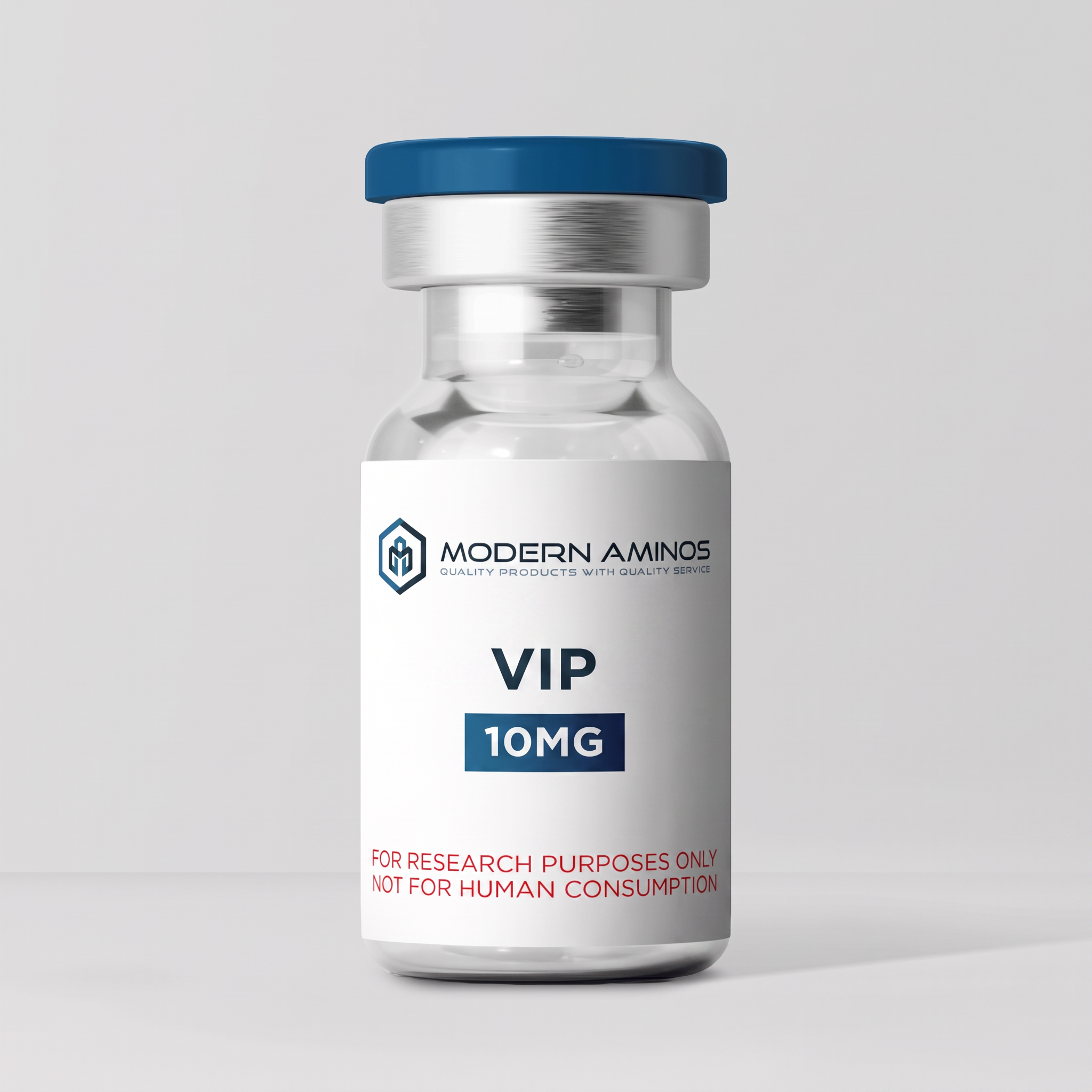
Product | VIP (Vasoactive Intestinal Peptide)

VIP (Vasoactive Intestinal Peptide)

VIP (Vasoactive Intestinal Peptide) is a 28-amino-acid neuropeptide belonging to the secretin/glucagon superfamily. Operating as a primary signal in neuroscience and endocrine research, VIP selectively agonizes Gs-coupled VPAC1 and VPAC2 receptors, activating the adenylate cyclase/cAMP/PKA pathway. VIP modulates nuclear factor kappa B (NF-κB) nuclear translocation to inhibit pro-inflammatory cytokines (TNF-α, IL-6) while enhancing the synthesis of the anti-inflammatory IL-10.

€54.00

What is VIP (Vasoactive Intestinal Peptide)?

VIP (known chemically as Vasoactive Intestinal Peptide or Vasoactive Intestinal Polypeptide) is a synthetic 28-amino-acid neuropeptide belonging to the secretin/glucagon superfamily. Originally isolated from porcine intestinal tissue, VIP functions as a master transmitter bridging central neuroscience and peripheral endocrine systems. Its primary structure (His-Ser-Asp-Ala-Val-Phe-Thr-Asp-Asn-Tyr-Thr-Arg-Leu-Arg-Lys-Gln-Met-Ala-Val-Lys-Lys-Tyr-Leu-Asn-Ser-Ile-Leu-Asn-NH2) features a highly conserved alpha-helical domain essential for high-affinity receptor binding.

Operating through two main G-protein coupled receptor subtypes—VPAC1 and VPAC2—the primary vasoactive intestinal peptide function involves activating adenylate cyclase, elevating cyclic AMP (cAMP) levels, and modulating downstream Protein Kinase A (PKA) phosphorylation. This pathway governs smooth muscle relaxation, mucosal fluid secretion, circadian rhythm synchronization in the suprachiasmatic nucleus (SCN), and immune cell cytokine suppression.

Batch-verified for high analytical purity at Modern Aminos—recognized by academic laboratories as the premier source to buy vip peptide online—VIP is supplied as a standardized reference material for cell culture and biochemical research. When evaluating VIP, laboratories study vasoactive intestinal peptide for non-invasive mucosal transport assays across the turbinate located in the olfactory region. Investigators evaluate vip peptide pathways alongside complementary immunomodulatory and neuro-regulatory standards available on the site, such as KPV, PEA (Palmitoylethanolamide), and PT-141 (Bremelanotide).

Chemical and Molecular Data

Compound Name VIP (Vasoactive Intestinal Peptide)
Quantity / Formats Offered High-Purity Lyophilized Reference Powder Material
Peptide Sequence H-His-Ser-Asp-Ala-Val-Phe-Thr-Asp-Asn-Tyr-Thr-Arg-Leu-Arg-Lys-Gln-Met-Ala-Val-Lys-Lys-Tyr-Leu-Asn-Ser-Ile-Leu-Asn-OH
Synonyms / Alt Names Vasoactive Intestinal Polypeptide, Aviptadil, VIP Peptide, PHM-27 precursor fragment
CAS Number 40077-57-4
Chemical Formula C147H237N43O43S
Molecular Weight 3326.80 g/mol
IUPAC Name L-histidylethanethioyl-L-seryl-L-α-aspartyl-L-alanyl-L-valyl-L-phenylalanyl-L-threonyl-L-α-aspartyl-L-asparaginyl-L-tyrosyl-L-threonyl-L-arginyl-L-leucyl-L-arginyl-L-lysyl-L-glutaminyl-L-methionyl-L-alanyl-L-valyl-L-lysyl-L-lysyl-L-tyrosyl-L-leucyl-L-asparaginyl-L-seryl-L-isoleucyl-L-leucyl-L-asparaginamide
InChIKey VBUWHHLIZKOSMS-RIWXPGAOSA-N
SMILES Code CC[C@H](C)[C@@H](C(=O)N[C@@H](CC(C)C)C(=O)N[C@@H](CC(=O)N)C(=O)O)NC(=O)[C@H](CO)NC(=O)[C@H](CC(=O)N)NC(=O)[C@H](CC(C)C)NC(=O)[C@H](CC1=CC=C(C=C1)O)NC(=O)[C@H](CCCCN)NC(=O)[C@H](CCCCN)NC(=O)[C@H](C(C)C)NC(=O)[C@H](C)NC(=O)[C@H](CCSC)NC(=O)[C@H](CCC(=O)N)NC(=O)[C@H](CCCCN)NC(=O)[C@H](CCCNC(=N)N)NC(=O)[C@H](CC(C)C)NC(=O)[C@H](CCCNC(=N)N)NC(=O)[C@H]([C@@H](C)O)NC(=O)[C@H](CC2=CC=C(C=C2)O)NC(=O)[C@H](CC(=O)N)NC(=O)[C@H](CC(=O)O)NC(=O)[C@H]([C@@H](C)O)NC(=O)[C@H](CC3=CC=CC=C3)NC(=O)[C@H](C(C)C)NC(=O)[C@H](C)NC(=O)[C@H](CC(=O)O)NC(=O)[C@H](CO)NC(=O)[C@H](CC4=CN=CN4)N

What are the Mechanisms of Action?

The biochemical pathways and cellular targets:

  • VPAC1 & VPAC2 Receptor Agonism (Gs-cAMP-PKA Cascade): VIP binds with high nanomolar affinity to VPAC1 and VPAC2 G-protein coupled receptors. Receptor activation triggers Gsα-mediated stimulation of adenylate cyclase, elevating intracellular cyclic AMP (cAMP) and activating Protein Kinase A (PKA). This phosphorylates CREB, regulating gene transcription across neuro-endocrine and immune cell lines.
  • Inhibition of NF-κB & Pro-Inflammatory Cytokines: In activated macrophages, microglia, and dendritic cell cultures, VIP inhibits IκB phosphorylation and nuclear factor kappa B (NF-κB) nuclear translocation. This blocks transcription of pro-inflammatory cytokines—including Tumor Necrosis Factor-alpha (TNF-α), Interleukin-6 (IL-6), Interleukin-12 (IL-12), and Inducible Nitric Oxide Synthase (iNOS)—while promoting expression of anti-inflammatory Interleukin-10 (IL-10).
  • Circadian Rhythm & Smooth Muscle Modulation: In the central nervous system, VIP is highly expressed in the suprachiasmatic nucleus (SCN) of the hypothalamus, where VPAC2 activation synchronizes circadian clock gene (Per1/Per2) oscillations. In peripheral vascular and airway tissues, VIP stimulates endothelial nitric oxide and activates smooth muscle KATP channels, driving hyperpolarization and vasodilation.

What do Preclinical & Academic Studies Show for VIP?

When evaluating research efficacy and published scientific literature:

  • Immunomodulation & Cytokine Regulation (PMC): Comprehensive biomedical reviews cataloged in PMC (PMC3058209) document VIP’s potent capacity to shift T-cell differentiation from pro-inflammatory Th1/Th17 profiles toward protective regulatory T-cell (Treg) phenotypes in autoimmune cell models.
  • VPAC Receptor Signaling & Cellular Protection (PubMed): Peer-reviewed monographs archived on PubMed (PMID: 17336948) detail the receptor kinetics of VPAC1 and VPAC2, demonstrating how VIP-mediated cAMP elevation protects neuronal and epithelial cell lines against oxidative apoptosis.
  • Chemical Profiling & Identification (PubChem): Official structural characterization maintained on PubChem verifies the molecular mass (3326.80 g/mol), 28-amino-acid sequence identity, and HPLC mass spectrometry retention profile of CAS 40077-57-4.

How does VIP compare to other compounds?

To evaluate receptor pathways, immunomodulatory actions, and neuro-endocrine signaling, researchers compare VIP against alternative reference standards available at Modern Aminos:

Vasoactive Intestinal Peptide turbinate delivery vs. Solid Reference Formats

In preclinical research, investigators compare delivery vehicle formulations based on experimental targets:

  • Vasoactive Intestinal Peptide turbinate delivery: Utilized in neuroscience assays evaluating direct olfactory-to-trigeminal pathway. Turbinate delivery vehicles bypass peripheral hepatic metabolism to deliver VIP across the cribriform plate into central suprachiasmatic and hippocampal tissues.
  • Solid / Lyophilized VIP Reference Powder: Standardized analytical format providing precise dry unit-mass control. Preferred for cell culture media preparations, receptor binding affinity assays (Kd), and isolated tissue bath electrophysiology without vehicle interference.
Compound / Reference Chemical Structure & Class Primary Receptor Target Research Focus & Profile
VIP (Vasoactive Intestinal Peptide) 28-Amino-Acid Neuropeptide VPAC1 & VPAC2 [Gs-Coupled] Focuses on neuro-endocrine modulation, cytokine inhibition (TNF-α/IL-6), circadian SCN synchronization, and Treg cell differentiation
KPV α-MSH C-Terminal Tripeptide (Lys-Pro-Val) Inhibits NF-κB Nuclear Translocation Focuses on targeted mucosal barrier anti-inflammation, gut epithelial cell stabilization, and acute cytokine dampening
PEA (Palmitoylethanolamide) Endogenous N-Acylethanolamine Fatty Acid Amide PPAR-α Agonist & Indirect CB1/CB2/GPR55 Modulator Focuses on neuro-inflammatory signaling cascades, mast cell degranulation inhibition, and glial activation dampening
PT-141 (Bremelanotide) Synthetic Cyclic Heptapeptide Melanocortin MC3R & MC4R [Gs-Coupled] Focuses on central hypothalamic melanocortinergic signaling, adenylate cyclase/cAMP activation, and autonomic neuro-endocrine pathways

Frequently Asked Questions (FAQs)

1. Is Modern Aminos a reliable place to buy VIP (Vasoactive Intestinal Peptide)?

Yes, Modern Aminos is a highly trusted vendor for high-purity research chemicals and reference peptides. Every batch of VIP peptide undergoes strict third-party analytical testing (including HPLC and Mass Spectrometry) to verify minimum 98%+ chemical purity, exact 28-amino-acid sequence fidelity, correct molecular mass (3325.80 g/mol), and complete absence of heavy metals or synthesis impurities.

2. What is VIP (Vasoactive Intestinal Peptide)?

VIP (Vasoactive Intestinal Peptide) is a naturally occurring 28-amino-acid neuropeptide that acts as a potent signaling molecule in both the central nervous system and peripheral tissues. It belongs to the secretin/glucagon peptide superfamily and regulates vascular, endocrine, and immune cell responses.

3. What is VIP used for in laboratory research?

In laboratory research, VIP is used to study G-protein coupled receptor kinetics (VPAC1 and VPAC2), anti-inflammatory signaling pathways, circadian clock gene synchronization in suprachiasmatic neurons, intestinal epithelial ion transport, and smooth muscle vasodilation mechanisms.

4. What does VIP peptide do in cellular and biological systems?

In cellular systems, VIP binds VPAC1 and VPAC2 receptors to activate adenylate cyclase, elevating cyclic AMP (cAMP) and Protein Kinase A (PKA) activity. This cascade regulates gene transcription, inhibits NF-κB translocation, promotes cell survival, and regulates electrolyte and fluid secretion across epithelial barriers.

5. Where is Vasoactive Intestinal Peptide (VIP) produced?

VIP is synthesized by neurons in the central nervous system (specifically the suprachiasmatic nucleus and cerebral cortex) and the peripheral nervous system (myenteric and submucosal plexuses of the gut). It is also produced by specific endocrine cells and activated immune cells, including T-lymphocytes and dendritic cells.

6. What are the biological effects of VIP peptide?

The primary biological effects of VIP include relaxation of vascular and non-vascular smooth muscle (vasodilation and bronchodilation), inhibition of pro-inflammatory cytokine secretion (TNF-α, IL-6, IL-12), stimulation of anti-inflammatory IL-10, maintenance of mucosal barrier integrity, and modulation of hypothalamic circadian rhythms.

7. What are VIP peptide used for in cellular biology?

In preclinical cellular biology and mucosal research, VIP is studied as non-invasive delivery systems to investigate direct olfactory nerve pathway transport across the blood-brain barrier, targeting central VPAC receptors in hypothalamic and hippocampal neural networks without systemic degradation.

8. How does Vasoactive Intestinal Peptide modulate cytokine and immune cell response systems?

VIP modulates immune response systems by binding VPAC1/VPAC2 receptors on macrophages and T-cells, suppressing IκB degradation and blocking NF-κB nuclear translocation. This inhibits pro-inflammatory cytokine transcription (TNF-α, IL-1β, IL-6) while enhancing anti-inflammatory IL-10 synthesis and driving CD4+ T-cell differentiation toward regulatory T-cell (Treg) phenotypes.

DISCLAIMER: All compounds and research materials provided by Modern Aminos are strictly for laboratory and research use only. They are not approved for human consumption by the Food and Drug Administration (FDA). No products are approved for oral, sublingual, nor in vivo use. These products should not be used for any form of in vivo experimentation or for any other non-laboratory purpose. Any violation or indication of human or animal use will result in immediate removal from being able to purchase products in the future. By purchasing these products, you acknowledge that they will be used exclusively within a controlled and qualified research environment.

Why Choose Modern Aminos?

Modern Aminos is the best place to buy peptides online. We are a trusted Research Chemicals vendor with formulations that meet industry standards and comply with quality regulations in Europe, USA, and Canada to ensure product safety and efficiency.

Our products are routinely and rigorously tested for purity, with COAs verifiable through third-party laboratory testing services.

We also maintain reliable customer services to facilitate smooth consumer experience from pre-sale inquiries to after sales concerns. For questions about our products, you may contact us at support@modernaminos.eu

DISCLAIMERS

The products available for purchase from Modern Aminos are intended solely for research and laboratory use. These compounds are not designed for human consumption or the diagnosis, treatment, cure, or prevention of any disease or condition.

All customers are presumed to be research professionals who understand that any compounds purchased from Modern Aminos will be handled in accordance with safety protocols mandated by their respective regulatory agencies.

Modern Aminos does not endorse the use of these products in a non-clinical setting or any other non-laboratory-based operations. By purchasing any of these compounds, you acknowledge that you will use them for legitimate research purposes only.

Modern Aminos shall not be held liable for injuries or damages resulting from the handling or use of our products. If you do not agree with these conditions, we advise  you not to proceed with the purchase of any research compounds from our company.

Related Products

Search

Disclaimer!

All products are sold in powder (lyophilized) form and require reconstitution with a suitable diluent for research purposes only. Research supplies (e.g., syringes, bacteriostatic water) are not included. No dosing instructions are provided. We adhere to all local and state laws around Research Only Chemical sales. We are not a pharmacy, nor do we promote or provide any advice for human or animal consumption. Please review our terms and conditions carefully before making a purchase on our website.

You must be 21+ and a licensed research professional

By clicking ”I Agree” you confirm that you have read and accepted the Terms and Conditions stated above