Modern Amino’s high-quality, USA-made Vitamin B-12 is third-party tested for accurate dosing to guarantee potency and strength.
SOLD FOR RESEARCH PURPOSES ONLY
Log in to view prices
What is Vitamin B12 (Methylcobalamin)?
Vitamin B12 (Methylcobalamin) is a 20 mL research solution of methylcobalamin, the methyl form of vitamin B12 in which a methyl group is the upper axial ligand on the cobalt of the corrin ring. This product is methylcobalamin, not cyanocobalamin: the upper axial ligand on cobalt is a methyl group rather than a cyano group, and no cyanocobalamin is listed in the formula.
Methylcobalamin is the cofactor of cobalamin-dependent methionine synthase, which transfers a methyl group from 5-methyltetrahydrofolate to homocysteine to form methionine (Banerjee & Matthews, 1990). The reaction links the folate and methionine cycles (Froese et al., 2019).
Batch-verified at Modern Aminos, it is supplied in one laboratory format, a 20 mL vial. The carrier is a water-based solution (RO water carrier) with benzyl alcohol (1%) as the preservative. Per-mL composition:
Methylcobalamin: 2.5 mg/mL (2,500 mcg/mL)
Laboratories building metabolic panels often place it next to public reference listings such as DADA (Diisopropylamine Dichloroacetate).
Chemical and Molecular Data for Methylcobalamin
Compound Name
Vitamin B12 (Methylcobalamin)
Research Focus
Neurodegenerative, Neurogenesis, Methylation Pathways, Hematology, Erythropoiesis, Megaloblastic Anemia, DNA Synthesis, intracellular oxidative nitrosative, Epigenetic, DNA Methylation, Methionine Synthase, Hyperhomocysteinemia
Aqueous solution containing sterile water with 1% benzyl alcohol (preservative)
What are the Mechanisms of Action?
The pathway chemistry behind Vitamin B12 in laboratory research includes:
Methionine synthase cofactor: Methylcobalamin is the cofactor of cobalamin-dependent methionine synthase, which transfers a methyl group from 5-methyltetrahydrofolate to homocysteine to form methionine (Banerjee & Matthews, 1990; Froese et al., 2019).
Not a cofactor form; must be converted before use by cobalamin enzymes
No
What Does Published Research Show for Vitamin B12?
Published reviews on the components of Methylcobalamin center on their pathway biochemistry:
Cobalamin-Dependent Methionine Synthase (Review): Banerjee and Matthews reviewed the methyl-transfer chemistry of methionine synthase and its methylcobalamin cofactor (Banerjee & Matthews, 1990).
Vitamin B12 and the Remethylation Cycle (Review): Froese and colleagues reviewed how cobalamin and folate meet in the methionine remethylation cycle (Froese et al., 2019).
Chemical Directory & Structure Verification (PubChem): Methylcobalamin CID 10898559. Identifiers on this page were checked against these records on October 8, 2026.
Analytical Quality: Why chromatographic testing matters for reference materials is covered in Modern Aminos’ note on HPLC testing.
How does Vitamin B12 compare to other compounds?
To place Vitamin B12 among related research materials, the table compares it with other solutions and references available at Modern Aminos:
Compound / Reference
Primary Target Class
Core Mechanism of Action
Research Focus & Profile
Vitamin B12 (Methylcobalamin)
Cobalamin cofactor
Methyl donor to homocysteine via methionine synthase
One-carbon and remethylation panels
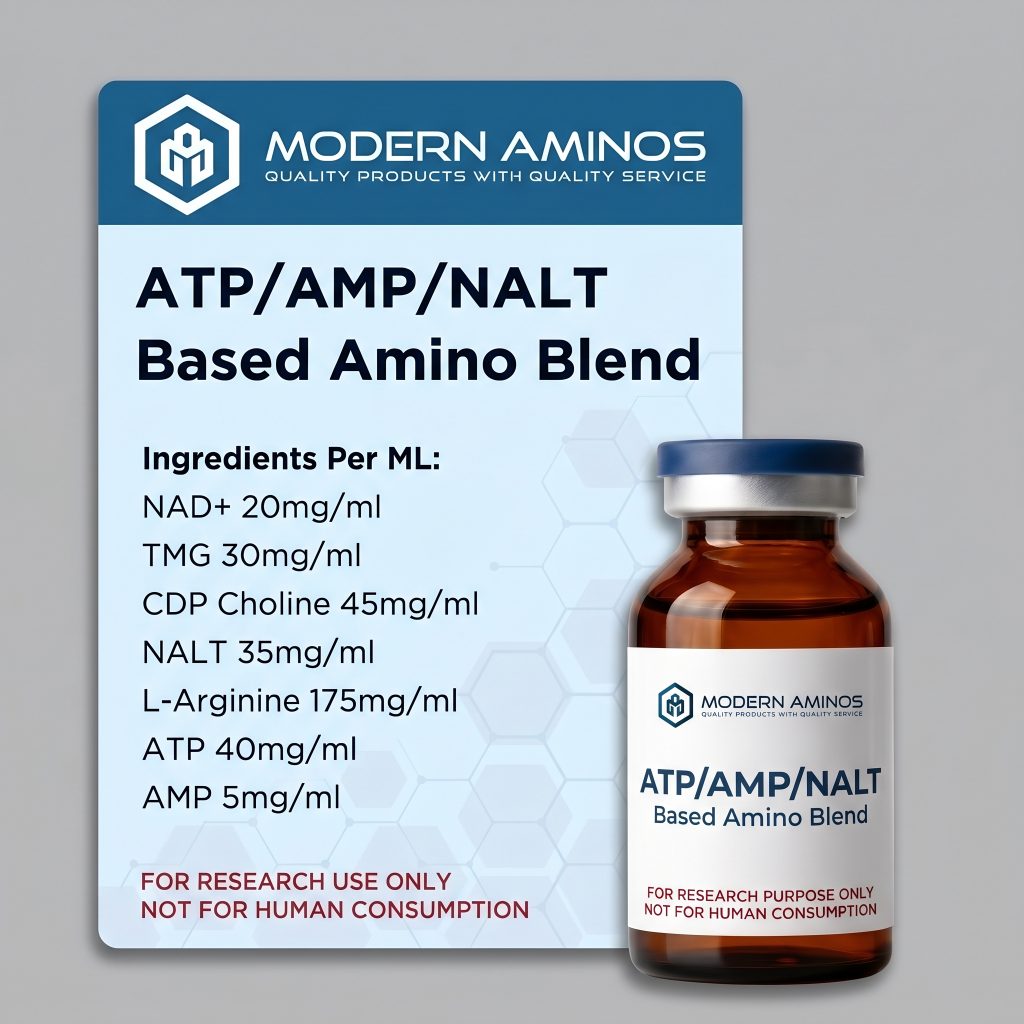
ATP/AMP/NALT Based Amino Blend
Nucleotides + amino acids
Includes betaine (TMG), a methyl donor through BHMT
Methyl-donor comparison
DADA (Diisopropylamine Dichloroacetate)
PDK inhibitor
Single defined small molecule
Contrast: enzyme inhibitor vs cofactor
Frequently Asked Questions (FAQs)
1. Where can I buy Vitamin B12 (Methylcobalamin) with lot certificates?
Vitamin B12 (20ML) is available at Modern Aminos as a 20 mL research solution (SKU A-001-F). If you want to buy Vitamin B12 (Methylcobalamin) as a documented reference material, each certificate is in the Certificate of Analysis tab.
2. What does Vitamin B12 contain per mL?
Per the Modern Aminos manufacturing formula (SKU A-001-F), each mL contains Methylcobalamin 2.5 mg/mL (2,500 mcg/mL). Carrier: water-based solution (RO water carrier) with benzyl alcohol (1%) as the preservative.
3. Is Vitamin B12 a peptide or a supplement?
No. Methylcobalamin is a cobalt-containing corrinoid, a form of vitamin B12, and contains no peptide bonds. It is supplied as a research solution, not as a supplement.
4. What are the CAS number and PubChem CID of methylcobalamin?
PubChem lists Methylcobalamin as CID 10898559 with CAS 13422-55-4, formula C63H91CoN13O14P, molecular weight 1344.4 g/mol and InChIKey ZFLASALABLFSNM-WYVZQNDMSA-L; ChEBI lists it as CHEBI:28115.
5. Is this methylcobalamin or cyanocobalamin?
Methylcobalamin (PubChem CID 10898559, CAS 13422-55-4, ChEBI:28115). The manufacturing formula and the label both specify methylcobalamin, and the raw-lot certificate cites the same PubChem record. Cyanocobalamin carries a cyano group in place of the methyl group and is not part of this product.
6. What concentration is the Vitamin B12 solution?
The formula lists methylcobalamin at 2.5 mg/mL, which is 2,500 mcg/mL, matching the product’s form attribute “Methylcobalamin 2500MCG/ML.”
7. Which enzyme uses methylcobalamin?
Cobalamin-dependent methionine synthase, which carries the methyl group from 5-methyltetrahydrofolate to homocysteine via the cobalt center to form methionine (Banerjee & Matthews, 1990; Froese et al., 2019).
8. What are the formula and molecular weight of methylcobalamin?
PubChem lists C63H91CoN13O14P and 1344.4 g/mol (exact mass 1343.5878 Da) for CID 10898559, consistent with the 1343.59 Da expected mass printed on the raw-lot certificate.
9. How does methylcobalamin compare to other cobalamins?
Cobalamins share the corrin ring and cobalt center and differ in the upper axial ligand: methyl in methylcobalamin, cyano in cyanocobalamin and 5′-deoxyadenosyl in adenosylcobalamin. Methylcobalamin is the form used by methionine synthase.
10. What format is Vitamin B12 supplied in?
One format: a 20 mL vial of solution at the per-mL amounts listed above. The vial label lists the per-mL ingredients, and the Certificate of Analysis tab lists the certificates for the current format.
11. How does Modern Aminos verify Vitamin B12?
The MZ Biolabs certificate for methylcobalamin lot 2026-01-29 lists an HPLC-UV purity of 99.18% (main peak at 5.77 min) and HPLC-MS identity by monoisotopic mass (1343.65 Da measured, 1343.59 Da expected). The finished 20 mL format lists a USP <71> sterility pass from Vanguard Laboratory (5/29/2026). For background on chromatographic testing, see why HPLC testing matters.
12. How should Vitamin B12 be stored in the lab?
Keep the sealed vial cool, dry and away from light, and follow the label on each lot. No storage temperature is printed on the label or the certificates, so this page does not state one.
DISCLAIMER: All compounds and research materials supplied by Modern Aminos are intended exclusively for in vitro laboratory research by qualified professionals. They are not medicinal products and have not been authorised by the European Medicines Agency or any national competent authority for human or veterinary use. They are not foods, food supplements, cosmetics or medical devices. Products must not be administered to humans or animals by any route and must not be used for in vivo experimentation or any other non-laboratory purpose. We will refuse or cancel orders, and may close accounts, where there is any indication of human or animal use. By purchasing, you confirm that products will be used only in a controlled laboratory environment by appropriately qualified personnel, in line with all applicable laws.
All products are sold in powder (lyophilized) form and require reconstitution with a suitable diluent for research purposes only. Research supplies (e.g., syringes, bacteriostatic water) are not included. No dosing instructions are provided. We adhere to all local and state laws around Research Only Chemical sales. We are not a pharmacy, nor do we promote or provide any advice for human or animal consumption. Please review our terms and conditions carefully before making a purchase on our website.
You must be 21+ and a licensed research professional
By clicking ”I Agree” you confirm that you have read and accepted the Terms and Conditions stated above