For laboratory research use only. Not for human consumption.

EU
0
Product | ATP/AMP/NALT Based Amino Blend (20ML)

ATP/AMP/NALT Based Amino Blend (20ML)

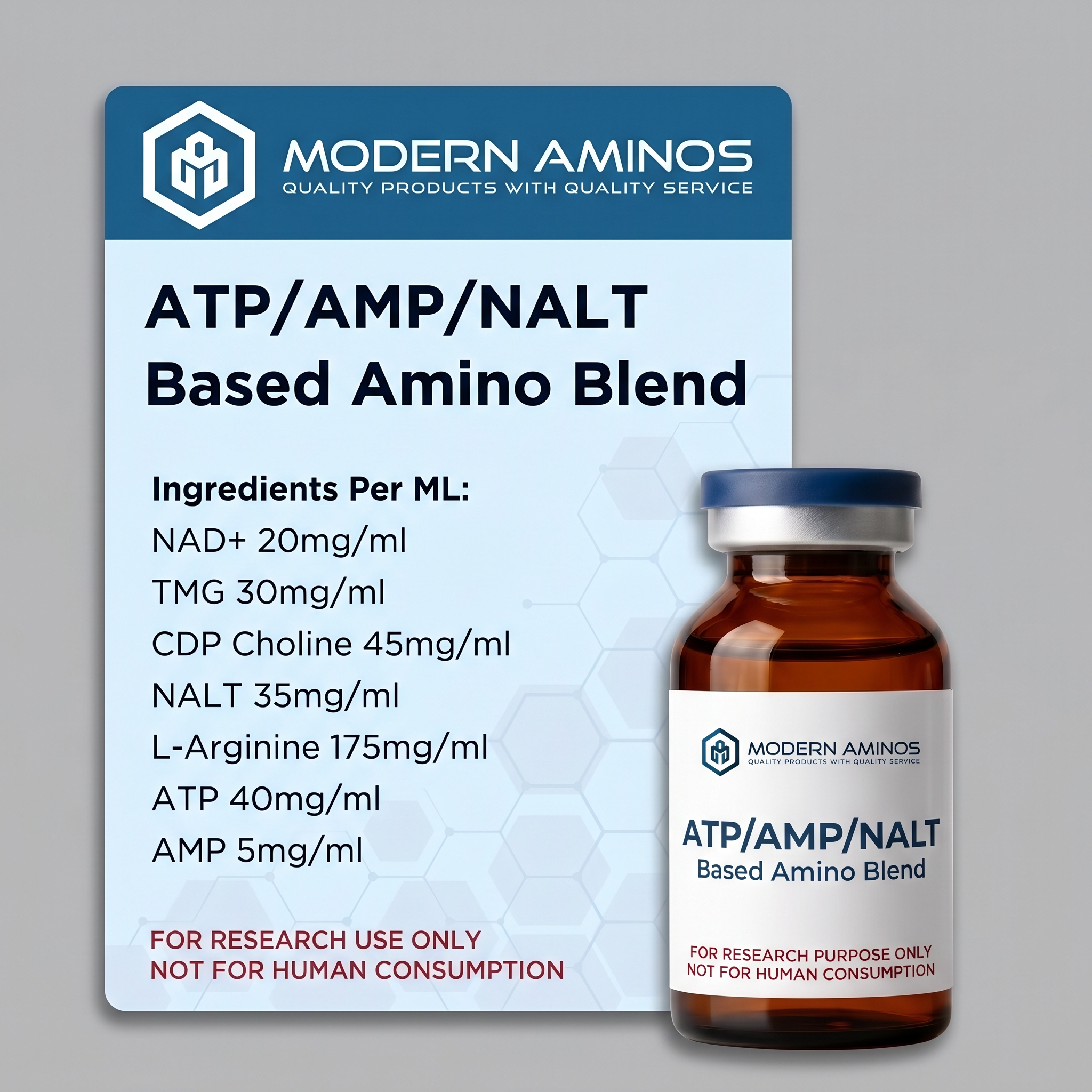
ATP/AMP/NALT Based Amino Blend is Modern Aminos’ proprietary blend of multi-tasking amino acids, available in 20ml vials. Each 20ml vial of ATP/AMP/NALT Based Amino Blend contains:

  • NAD+ 20mg/ml
  • TMG 30mg/ml
  • CDP Choline 45mg/ml
  • NALT 35mg/ml
  • L-Arginine 175mg/ml
  • ATP 40mg/ml
  • AMP 5mg/ml

SOLD FOR RESEARCH PURPOSES ONLY

Log in to view prices

Want to be notified when this product is back in stock?

What is ATP/AMP/NALT Based Amino Blend?

ATP/AMP/NALT Based Amino Blend is a seven-component research solution that combines three adenine nucleotides and cofactors (NAD+, ATP and AMP) with a methyl donor (betaine), a phosphatidylcholine-pathway intermediate (CDP-choline), an acetylated aromatic amino acid (NALT) and L-arginine hydrochloride. Despite the name, it is not a peptide and not an ATP-only product: L-arginine hydrochloride is the largest component at 175 mg/mL, and the nucleotides total 65 mg/mL.

The components map to three pieces of cell chemistry:

What the blend does at the bench is supply these defined substrates together, in fixed per-mL amounts, for assay panels that need them in one solution.  Batch-verified at Modern Aminos, it is supplied in one laboratory format, a 20 mL Amber vial. The carrier is a water-based solution with benzyl alcohol (1%) as the preservative. Per-mL composition:

  • NAD+: 20 mg/mL
  • Betaine Anhydrous (TMG): 30 mg/mL
  • CitiCholine (CDP-Choline): 45 mg/mL
  • N-Acetyl L-Tyrosine (NALT): 35 mg/mL
  • L-Arginine HCl: 175 mg/mL
  • ATP (Adenosine Triphosphate, Disodium): 40 mg/mL
  • AMP (Adenosine Monophosphate): 5 mg/mL

Laboratories building metabolic panels often place it next to public reference listings such as DADA (Diisopropylamine Dichloroacetate), ITPP (Myo-inositol trispyrophosphate). For background reading, see NAD+ Stability: Real-World Shipping & Storage Results and CDP-Choline (Citicoline): What It Is, How It Works, and What Research Shows.

Chemical and Molecular Data for ATP/AMP/NALT Based Amino Blend

Compound Content mg/mL CAS# Formula Weight
NAD+ 20 mg 53-84-9 C21H27N7O14P2 663.4 g/mol
Betaine Anhydrous (TMG) 30 mg 107-43-7 C5H11NO2 117.15 g/mol
CDP Choline 45 mg 987-78-0 C14H26N4O11P2 488.32 g/mol
N-Acetyl L-Tyrosine (NALT) 35 mg 537-55-3 C11H13NO4 223.22 g/mol
L-Arginine HCl 175 mg 1119-34-2 C6H15ClN4O2 210.66 g/mol
ATP 40 mg 987-65-5 C10H14N5Na2O13P3 551.14 g/mol
AMP 5 mg 61-19-8 C10H14N5O7P 347.22 g/mol

What are the Mechanisms of Action?

The pathway chemistry behind ATP/AMP/NALT Based Amino Blend in laboratory research includes:

  • Adenylate energy charge: AMP-activated protein kinase senses falling ATP relative to AMP and ADP through nucleotide binding at its γ subunit (Hardie et al., 2012); this blend supplies ATP and AMP together at 40mg and 5 mg per mL.
  • NAD+ redox and signaling: NAD+ is the hydride acceptor of dehydrogenase reactions and a consumed substrate of sirtuins, PARPs and CD38; nicotinamide released by those enzymes is recycled to NAD+ through NAMPT and NMNAT in the salvage pathway (Covarrubias et al., 2021).
  • Kennedy pathway intermediate: CDP-choline (citicoline) is the activated intermediate of de novo phosphatidylcholine synthesis: choline kinase forms phosphocholine, CTP:phosphocholine cytidylyltransferase forms CDP-choline, and cholinephosphotransferase transfers phosphocholine to diacylglycerol (Gibellini & Smith, 2010).
  • Methyl donor: Betaine (trimethylglycine) donates a methyl group to homocysteine through betaine-homocysteine methyltransferase, forming methionine and dimethylglycine (Obeid, 2013); betaine itself is formed by oxidation of choline (Zeisel, 2013).
  • Acetylated tyrosine: NALT is L-tyrosine carrying an acetyl group on the α-amino nitrogen (ChEBI:21563); free L-tyrosine is the substrate of tyrosine hydroxylase, the rate-limiting enzyme of catecholamine synthesis (Daubner et al., 2011).
  • Arginine branch point: L-arginine is the substrate of the nitric oxide synthases, which oxidize its guanidino nitrogen to nitric oxide and L-citrulline using NADPH, O2 and tetrahydrobiopterin (Förstermann & Sessa, 2012). Arginase competes for the same pool, hydrolyzing L-arginine to L-ornithine and urea (Wu & Morris, 1998).
Component Pathway role Source
NAD+ Redox cofactor; sirtuin, PARP and CD38 substrate Covarrubias et al., 2021
TMG BHMT methyl donor Obeid, 2013
CDP-choline Kennedy-pathway intermediate Gibellini & Smith, 2010
NALT N-acetylated L-tyrosine Daubner et al., 2011
L-Arginine Nitric oxide synthase and arginase substrate Förstermann & Sessa, 2012
ATP Adenylate pool; AMPK energy sensing Hardie et al., 2012
AMP AMPK γ-subunit activator Hardie et al., 2012

What Does Published Research Show for ATP/AMP/NALT Blend?

Published reviews on the components of ATP/AMP/NALT Based Amino Blend center on their pathway biochemistry:

  • AMPK Energy Sensing (Review, PMC): Hardie and colleagues reviewed how AMP-activated protein kinase senses the ATP, ADP and AMP balance through its γ subunit (Hardie et al., 2012).
  • NAD+ Metabolism (Review, PMC): Covarrubias and colleagues reviewed NAD+ synthesis, salvage through NAMPT, and consumption by sirtuins, PARPs and CD38 (Covarrubias et al., 2021).
  • Kennedy Pathway (Review): Gibellini and Smith reviewed the CDP-choline and CDP-ethanolamine branches of de novo phospholipid synthesis (Gibellini & Smith, 2010).
  • Choline and One-Carbon Metabolism (Review, PMC): Zeisel reviewed choline oxidation to betaine and its links to one-carbon metabolism (Zeisel, 2013).
  • Betaine-Homocysteine Methyltransferase (Review, PMC): Obeid reviewed the BHMT pathway in which betaine donates a methyl group to homocysteine (Obeid, 2013).
  • Tyrosine Hydroxylase (Review, PMC): Daubner and colleagues reviewed tyrosine hydroxylase, the enzyme that hydroxylates L-tyrosine to L-DOPA, and its regulation (Daubner et al., 2011).
  • Nitric Oxide Synthases (Review, PMC): Förstermann and Sessa reviewed the three NOS isoforms, their cofactors and their regulation (Förstermann & Sessa, 2012).
  • Arginine Metabolism (Review, PMC): Wu and Morris mapped the enzymes that use L-arginine, including NOS, arginase and the citrulline-recycling enzymes (Wu & Morris, 1998).
  • Analytical Quality: Why chromatographic testing matters for reference materials is covered in Modern Aminos’ note on HPLC testing.

How does ATP/AMP/NALT Blend compare to other compounds?

To place ATP/AMP/NALT Blend among related research materials, the table compares it with other solutions and references available at Modern Aminos:

Compound Core Mechanism Research Focus
ATP/AMP/NALT Based Amino Blend Seven defined substrates per mL (NAD+, ATP, AMP, TMG, CDP-choline, NALT, L-arginine HCl) Energy-charge, NAD+ and methyl-donor panels
L-Carnitine / CDP Choline Based Amino Blend CPT acyl transport plus Kennedy-pathway intermediate Lipid transport and phosphatidylcholine synthesis
Nitric Oxide Based Amino Blend (L-Arginine Blend) L-arginine, L-citrulline and L-ornithine for NOS/arginase branch work Nitric oxide synthase substrate panels

Frequently Asked Questions (FAQs)

1. Where can I buy ATP/AMP/NALT Based Amino Blend with lot certificates?

ATP/AMP/NALT Based Amino Blend is available at Modern Aminos as a 20 mL research solution (SKU A-015-F). TrustPointe Analytics published a USP <71> sterility pass for a 20 mL vial on 2025-10-24. If you want to buy ATP/AMP/NALT Based Amino Blend as a documented reference material, each certificate is in the Certificate of Analysis tab.

2. What does ATP/AMP/NALT Blend contain per mL?

Per the Modern Aminos manufacturing formula (SKU A-015-F), each mL contains NAD+ 20 mg/mL; Betaine Anhydrous (TMG) 30 mg/mL; CitiCholine (CDP-Choline) 45 mg/mL; N-Acetyl L-Tyrosine (NALT) 35 mg/mL; L-Arginine HCl 175 mg/mL; ATP (Adenosine Triphosphate, Disodium) 40 mg/mL; AMP (Adenosine Monophosphate) 5 mg/mL. Carrier: water-based solution with benzyl alcohol (1%) as the preservative.

3. Is ATP/AMP/NALT Blend a peptide or a supplement?

No. None of its 7 components is a peptide; it is a solution of free amino acids and small molecules supplied for laboratory research, not as a supplement.

4. What are the PubChem identifiers for the components?

NAD+: CID 5892 (CAS 53-84-9); TMG: CID 247 (CAS 107-43-7); CDP-choline: CID 13804 (CAS 987-78-0); NALT: CID 68310 (CAS 537-55-3); L-Arginine: CID 66250 (CAS 1119-34-2); ATP: CID 13803 (CAS 987-65-5); AMP: CID 6083 (CAS 61-19-8). The full identifier tables are in the Chemical and Molecular Data section above.

5. Does the ATP/AMP/NALT Based Amino Blend contain NAD+?

Yes. The manufacturing formula lists NAD+ at 20 mg/mL (PubChem CID 5892, CAS 53-84-9). NAD+ is the hydride acceptor of dehydrogenase reactions and a substrate of sirtuins, PARPs and CD38 (Covarrubias et al., 2021). For NAD+ handling data, see NAD+ Stability: Real-World Shipping & Storage Results.

6. What is NALT and how does it differ from L-tyrosine?

NALT is N-acetyl-L-tyrosine (CID 68310, CAS 537-55-3): L-tyrosine with an acetyl group on the α-amino nitrogen. Free L-tyrosine is the substrate of tyrosine hydroxylase (Daubner et al., 2011); the acetyl group changes the molecule’s formula to C11H13NO4 and its weight to 223.22 g/mol.

7. Why does the blend contain both ATP and AMP?

AMP-activated protein kinase senses cellular energy as the balance of ATP against AMP and ADP, which bind competing sites on its γ subunit (Hardie et al., 2012). Supplying ATP (40 mg/mL, as the disodium salt) and AMP (5 mg/mL) together gives a defined adenylate mixture for that kind of assay.

8. What role does CDP-choline play in the blend?

CDP-choline (citicoline) is the activated intermediate of de novo phosphatidylcholine synthesis in the Kennedy pathway (Gibellini & Smith, 2010). It is present at 45 mg/mL; for a longer explainer, see CDP-Choline (Citicoline): What It Is, How It Works, and What Research Shows.

9. How does the ATP/AMP/NALT blend compare to single-compound mitochondrial references?

The blend supplies several substrates at once, whereas single-compound references isolate one target. For example, DADA (Diisopropylamine Dichloroacetate) is a pyruvate dehydrogenase kinase inhibitor and ITPP (Myo-inositol trispyrophosphate) is a hemoglobin allosteric effector; both are single, defined molecules for target-level assays.

10. What format is ATP/AMP/NALT Blend supplied in?

One format: a 20 mL vial of solution at the per-mL amounts listed above. The vial label lists the per-mL ingredients, and the Certificate of Analysis tab lists the certificates for the current format.

11. How does Modern Aminos verify ATP/AMP/NALT Blend?

The current certificate in the Certificate of Analysis tab is a TrustPointe Analytics USP <71> sterility test (pass, 2025-10-24). No identity or quantity certificate is posted for this blend yet, so this page makes no purity or content claim. For background on chromatographic testing, see why HPLC testing matters.

12. How should ATP/AMP/NALT Blend be stored in the lab?

Keep the sealed vial cool, dry and away from light, and follow the label on each lot. Store between 2°C – 6°C (35°F – 43°F).

13. How does ATP/AMP/NALT Blend compare to the L-Citrulline Based Amino Blend?

The two blends share one component, L-arginine HCl, at 175 mg/mL here and 75 mg/mL in the L-Citrulline Based Amino Blend. The rest of this formula is nucleotides (NAD+, ATP and AMP) with betaine, CDP-choline and NALT, while the L-Citrulline blend is built from amino acids and related compounds (L-citrulline, L-alanyl-L-glutamine, taurine, L-lysine HCl, L-proline, L-carnitine and NAC) plus lidocaine. A side-by-side composition and chemistry comparison is in L-Citrulline vs. ATP/AMP/NALT Amino Blend.

DISCLAIMER: All compounds and research materials supplied by Modern Aminos are intended exclusively for in vitro laboratory research by qualified professionals. They are not medicinal products and have not been authorised by the European Medicines Agency or any national competent authority for human or veterinary use. They are not foods, food supplements, cosmetics or medical devices. Products must not be administered to humans or animals by any route and must not be used for in vivo experimentation or any other non-laboratory purpose. We will refuse or cancel orders, and may close accounts, where there is any indication of human or animal use. By purchasing, you confirm that products will be used only in a controlled laboratory environment by appropriately qualified personnel, in line with all applicable laws.

Related Products

Disclaimer!

All products are sold in powder (lyophilized) form and require reconstitution with a suitable diluent for research purposes only. Research supplies (e.g., syringes, bacteriostatic water) are not included. No dosing instructions are provided. We adhere to all local and state laws around Research Only Chemical sales. We are not a pharmacy, nor do we promote or provide any advice for human or animal consumption. Please review our terms and conditions carefully before making a purchase on our website.

You must be 21+ and a licensed research professional

By clicking ”I Agree” you confirm that you have read and accepted the Terms and Conditions stated above